

Norris Castle on the Isle of Wight is now on the market with Savills. Last year, The Georgian Group was instrumental in resisting very harmful proposals for the Grade I listed Castle and Farmstead and the registered landscape that connects them. The hotel and spa conversion proposals were refused at Planning Committee unanimously. Members can read our letter of objection to the scheme here. Now, the developer is marketing the estate and there is an opportunity for a sympathetic buyer to come forward and save this remarkable estate. Please help us and Historic England to spread the word. Click here to read the Savills press release.
About the Norris Estate
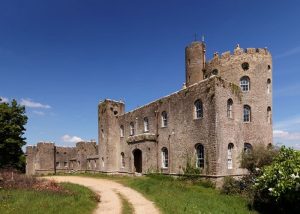
The picturesque beauty of the Norris Estate, which overlooks the Solent from the edge of East Cowes, has its origins in a modest farm. This farm was acquired and developed by the retired politician Lord Henry Seymour in 1795. Seymour appointed James Wyatt to design a model farm and kitchen garden within enclosed castellated walls, alongside a castellated Gothic Revival main house. The asymmetrical castle – of flint-galletted stone rubble with a dominating four storey round tower – was designed to awe and delight the viewer from the Solent. Construction of castle and farm began c. 1799.
In the same year, the landscape designer Humphry Repton began to lay out a 225-acre park on former fields to the south – connected by an oval carriage drive, and dotted with copses, cattle sheds and stone watering ponds. It is this combination of picturesque beauty and pleasing utility that lies at the heart of the estate’s special significance – along with its almost unique capacity to express the principles of the English landscape movement from which the park and buildings sprung. The layered aesthetic, historic and evidential significance described above led to Norris’s formal designation in 1987.
The parkland is registered at Grade I (the Island’s only such highly-graded landscape; Osborne to the east is Grade II*). The castle and farmstead are similarly listed at Grade I. As well as three Grade I designations, this exceptionally important ensemble includes eight heritage assets listed at Grade II – among them the sea wall, bathing house and pump house. The castle is included on Historic England’s Buildings at Risk Register as in “very bad” condition and category A “immediate risk”. Despite this neglect, the building survives in a largely unaltered state with many of its internal spaces and features intact. Wellington Estates acquired Norris at auction in February 2016 for £4.5million and, by 2017, it was apparent that the plan was to develop Norris into a luxury hotel resort.