

The Egyptian Revival Gillow Mausoleum, built c.1830 under the direction of Robert Gillow (d.1838) – a member of the prestigious English furniture-making company Gillow & Co founded in Lancaster in the eighteenth century – is one of five projects to receive grants totalling £20,000 from the F.E. Cleary Heritage Fund this year. The Fund is a charitable trust dedicated to the conservation of historic fabric dating from the Georgian period and is administered by the Georgian Group.
The largest single grant, of £9,100, will fund essential roof repairs to the Gillow Mausoleum in Thurnham, Lancashire, as part of restoration efforts led by Simon Gillow Reynolds, a descendant of the Gillow family. The mausoleum is not only the private burial place of the Gillow family, but an intriguing piece of architectural heritage which powerfully evokes British interest in Egyptian architecture in in the early nineteenth century. The structure’s design – notable for its ‘battered’ sloping walls of sandstone and four recessed Egyptian columns with bell capitals and papyrus decoration – has been attributed both to the sculptor, architect and Egyptologist Joseph Bonomi the Younger (1796-1878).
Simon Gillow Reynolds said: ‘As a descendant of the Furniture Gillows of Lancaster I have, for many years, looked in admiration on the Egyptian Temple that is the listed and unique creation of the early 19th century Robert Gillow, my three times great uncle. Standing in the Catholic Cemetery at Thurnham (Lancashire), it has been neglected and architecturally little known. Its damaged roof urgently needs repair which should now be possible due to the generosity of the Cleary Fund’.
Anya Lucas, the Group’s Director, said: ‘From the extraordinary Egyptian Revival Gillow Mausoleum in Lancashire to the glorious cast iron detailing of the Gothic Revival Gwrych Castle in Conwy, Wales, today’s grants represent the huge creative range of our period’s architecture. Targeted injections of grant funding can make a vital difference; by unlocking progress on restoration projects that would otherwise stall and helping to leverage other funding.’
The 2025 Cleary Fund recipients are:
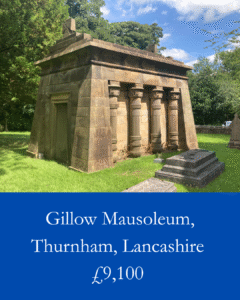
Gillow Mausoleum, Thurnham, Lancashire £9,100
Standing beside the Church of St. Thomas & St. Elizabeth, Thurnham, the Gillow Mausoleum was built c.1830 under the instruction of Robert Gillow, who lived at nearby Clifton Hall in Forton. He was a member of the Gillow family, founders of the renowned English furniture company Gillow & Co. In 1838, Robert Gillow himself was interred in the mausoleum.
The structure’s Egyptian style is particularly striking. Architectural historian Howard Colvin compared the Gillow Mausoleum to the Egyptian façade of Temple Mills in Leeds (1840) by Joseph Bonomi the Younger, suggesting that Bonomi may have been responsible for its design. Bonomi, later a Curator of Sir John Soane’s Museum, travelled to Egypt in the 1820s and 1830s and produced drawings and copies of ancient Egyptian monuments. Today, the mausoleum needs significant roof repairs. A descendant of the Gillow family, Simon Gillow Reynolds, has been leading the restoration effort and has secured a £20,000 grant from the Historic Houses Foundation. This left a shortfall of £9,109.76, which the Georgian Group is delighted to provide as part of this round of F.E. Cleary Fund grants.
Further information on the Gillow Mausoleum:
https://mmtrust.org.uk/mausoleum/gillow
https://historicengland.org.uk/listing/the-list/list-entry/1164592?section=official-list-entry
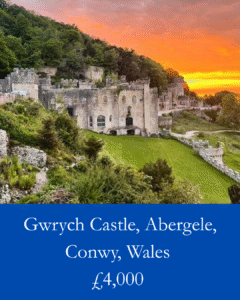
Gwrych Castle, Abergele, Conwy, Wales £4,000
Gwrych Castle is an extraordinary site of Gothic Revival, built between 1812 and 1825 for Lloyd Hesketh Bamford Hesketh, who wished to commemorate his mother’s family. He sought the advice of Gothic Revival architect Thomas Rickman on its design, whose influence is clear in the finished building.
Part of Rickman’s design involved the use of cast iron in the architectural detailing, thereby consulting the iron founder John Cragg. Much of this original work exists today in the surviving windows, but it is in need of restoration. The Gwrych Castle Preservation Trust, which owns the building today, is currently undertaking a multi-million-pound restoration over the next five years.
The Georgian Group is pleased to have awarded £4,000 towards the repair and conservation of the Gothic cast iron windows, which are an essential part of the neo-Gothic character of the structure. These works will allow the site to be enjoyed for a wide range of events and to contribute to the local economy.
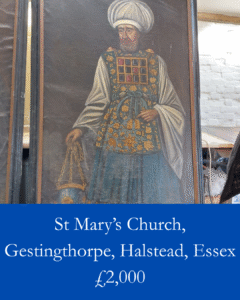
St Mary’s Church, Gestingthorpe, Halstead, Essex £2,000
Situated at the west end of St Mary the Virgin Church in Gestingthorpe, Essex are two striking pendant portraits of Moses and Aaron. Positioned on either side of the archway leading to the tower, both life-size paintings have been dated to c.1725 and were attributed to Robert Cardinall by Hugh Belsey. Both paintings remain in what are believed to be their original thin black and gilt frames. The paintings’ condition varies, with the portrait of Moses requiring more extensive conservation. As part of the planned works, the loose and flaking paint on both portraits will be consolidated. This project will be part-funded by the £2,000 awarded from the F.E. Cleary Fund, so that they can continue to contribute to the ecclesiastical context for which they were created.
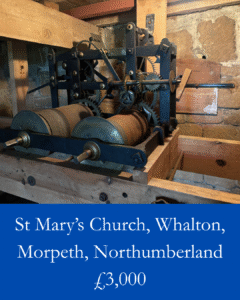
St Mary’s Church, Whalton, Morpeth, Northumberland £3,000
St Mary Magdalene in Whalton is a medieval parish church in an idyllic rural village of Northumberland. With foundations probably dating as far back as the Norman period, this church was subject to numerous stylistic changes – particularly in the 13th century.
Externally, the church walls are built from squared sandstone with cut dressings. On the east face of the tower, set on a stepped and chamfered plinth, is a single-handed turret clock with a movement dating to 1796. The clock’s frame bears a small brass plaque recording its installation by the Bates family. For many years, members of the community have wound the clock each week, forging a powerful link between the village and the church. The Group has awarded £3,000 towards the overhaul, repair, and reinstatement of the clock movement. In addition, the clock face will be repaired, enhancing views of the church tower.
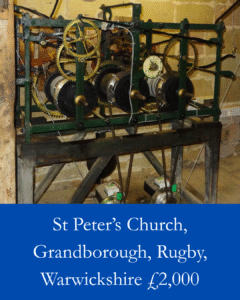
St Peter’s Church, Grandborough, Rugby, Warwickshire £2,000
St Peter’s Church largely dates from the 14th century, though documentary and archaeological evidence confirms that a church has stood on this site since at least the 11th century. Prominently positioned at the heart of the village, it serves both as a place of regular worship and as a centre of community activity. The church hosts a well-attended monthly farmers’ market, with a popular café and stalls run entirely by local volunteers, with proceeds directly supporting the building’s upkeep. A particularly distinctive and cherished feature is the historic church clock, whose quarter-hour chimes have long served as a timekeeping reference for village life and local agriculture. The clock contributes to the layered historic interest of the church, being a rare and remarkable example of mid-18th century horological craftsmanship. Its wrought iron ‘birdcage’ frame represents a construction style that predates the widespread adoption of cast iron frames after 1780. The applicant has been successful in fundraising for the clock’s repair and required £2,000 to meet the total cost.