
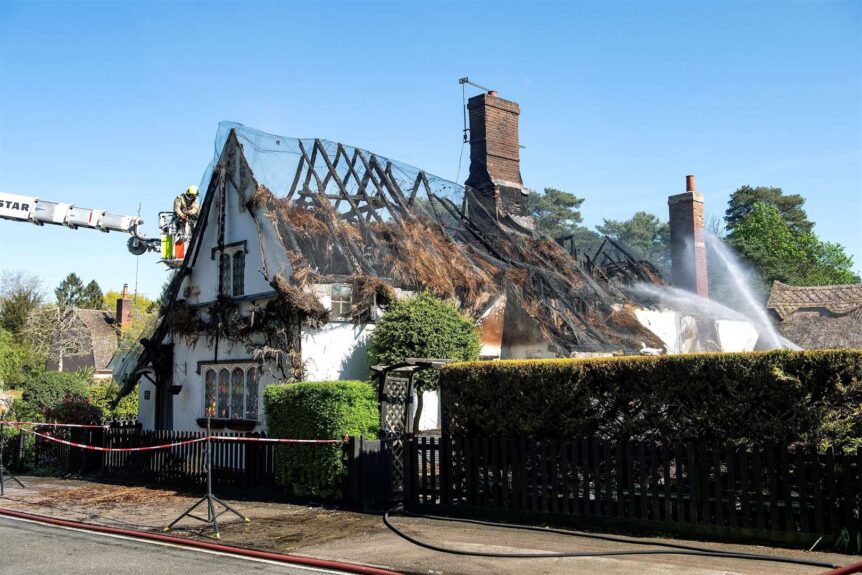
The Group has strongly objected to the total demolition of a group of Grade II listed cottages at Nos. 3-6 Bury Road, Hengrave, Suffolk which were probably constructed as a single dwelling in two phases in the late seventeenth or early eighteenth centuries. By the early nineteenth century the thatched timber framed building had been converted to four picturesque estate worker’s cottages. They stand directly opposite the north-east entrance gates to the Grade I Hengrave Hall. The cottages were extensively damaged by fire on the 25th of April 2022 and since have remained derelict.
Historic England have recently reviewed the listed status of the fire damaged buildings and recommended that they should remain on the statutory list, whilst West Suffolk Council have also approved an application for their full reinstatement, together with additions to the rear. At some point in 2023 however, the cover which had been protecting the fire damaged structure was removed (on whose authority it is not clear) and the building has now been unprotected for nearly two years. The Group has objected, along with other National Amenity Societies, to their demolition advising that a strong case for their destruction has not been made. Clarification as to who removed the building’s temporary protection and why is urgently needed.
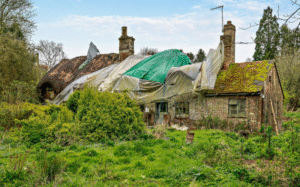
In addition, we have recently objected to the demolition of Box Cottage, Lower Green, near Hungerford (Grade II listed).
Whilst in a dilapidated state after years of vacancy, it still has significance as a vernacular cottage of the seventeenth/eighteenth century, with a considerable amount of surviving historic fabric; clear legibility of its historic planform; and evidence of traditional construction methods and materials, being of brick and flint, with a thatched roof.
Although a Structural Engineer’s Report had been submitted with the application, the findings were contradicted by Historic England’s structural assessment, which suggested measures whereby repair and reuse are feasible. As a result, the relevant policy of the NPPF was not triggered, stating that substantial loss (demolition) of a heritage asset should be founded on a clear demonstration, that there are no possible viable options for the reuse of the existing building or that the loss was outweighed by public benefit.
The Group did not consider that the application for demolition was justified and recommended that the LPA should refuse consent.